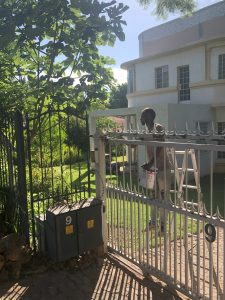
When I came to South Africa’s administrative capital, Pretoria, the first thing I noticed were the fences:
huge fences, of brick or metal, covered in barbed wire, electrified.
The entire city looks like a gigantic prison.
“We barely notice them anymore,” my colleagues said. “You’ll get used to it soon enough.”
I tried to get used to it. I tried not to notice.
I looked for other, more positive sides.
That’s why I waited six months to write this piece – I wanted to make sure I’m not overly influenced by my emotions and first impressions.
But now I can confidently say: I never did get used to it.
I don’t want to.
It’s awful watching a sunset through metal bars. I don’t like living in a city with a sign on every fence saying:
“Intruders will be apprehended by armed security forces.”
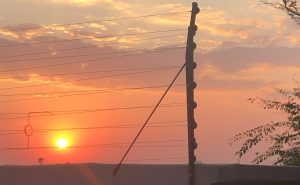
Pretoria was where I first saw a barbed wire surrounding a church, and as for my neighbours, not only do I not know them, I have never even set eyes on them. How could I, if we’re separated by such a tall fence?
What happened in this wonderful country?
Certainly, it started with Apartheid, but why has this separation not stopped with the fall of the system?
“What was Apartheid like? What did your daily lives look like?” I asked a black friend.
“It was awful,” she said. “We’d get taken out of our houses, we couldn’t even set foot in the white neighbourhoods, we lived behind fences.
In the evenings we couldn’t leave our homes, we had to carry special passports; if you were caught without one, they’d send you straight to jail, and anything could happen there.
Sometimes they would throw people out the window in the police station and tell their relatives they’d killed themselves.”
***
“What was Apartheid like? What did your daily lives look like?” I asked a white friend.
“We didn’t see anything odd. We simply lived our lives. It seemed normal for black and white people to have different schools, use separate entrances. At school we never spoke of it.
In my opinion, things were better then: it was safe, there was little unemployment, people respected each other.”
???

Before coming to South Africa, my knowledge of its history was limited to Invictus, a film starring Morgan Freeman as Nelson Mandela.
The film begins with a scene of Mandela returning from prison:
on one side of the road, black children in shabby clothes play football behind a cheap wire fence, while on the other, white children in tidy clean uniforms play rugby behind a sturdy white fence.
Thirty years later, walking around the same city, I see exactly the same images. Well, not exactly – the fences of white people are smarter, electrified and equipped with cameras and motion sensors.
But the idea of a fence hasn’t changed: here’s your side, here’s mine.
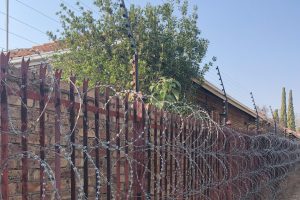
The longer I live in this city of fences, the more I think about them, and the more I hate them.
Fences don’t solve any problems:
they don’t help us listen, they don’t help us forgive, find peace or trust.
Why hasn’t a miracle happened in this city?
Why has it remained divided, people separated from each other by endless fences?
On a tour in the University of Pretoria, I saw the gold collection of a tribal king.
The object that caught my eye most was a large ring with a frog.
How interesting! “Why would a king carry a frog on his finger?” I asked the guide.
“A local proverb says, one cannot measure a frog’s length while it’s alive,” she explained.
It’s true, you can’t, whereas, when the frog is dead, it’s muscles ease, and you can measure its whole body.
To the king, this is a reminder: you cannot evaluate a ruler’s work during his lifetime. Only after his death does it become apparent what his legacy really was.
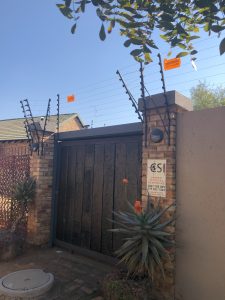
So I had a thought: if I were the queen of Pretoria, the first thing I would do is tear down all the fences! And issue a law forbidding the building of new ones. Perhaps in time I would become a legend.
History remembers wise rulers, doesn’t it?
What comes to mind are stories of the Doge of Venice ordering all gondolas to be painted black, or Genoa, where decorating building facades was limited, all for the same reason: to stop inhabitants from demonstrating their riches, indulging their pride and inviting others’ envy.
I remember traveling around Chicago and being surprised: none of the huge private houses had any fences (remember the house in Home Alone? No fence!) Locals explained fences were not allowed.
No wonder the first thing American tourists do in Pretoria is take photos of the fences.
They say they’ve never seen so many.
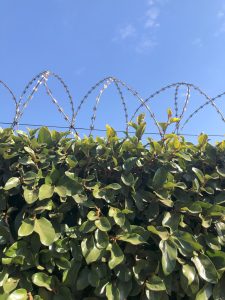
Oh, fences, fences… I wonder of my own fences as well.
I was born behind the Iron Curtain, so I understand the feeling. The worst of it is – exterior fences lead to interior ones, much harder to tear down, built from bad experiences, grudges, fears, anger, and distrust. Later, they are enforced still with the inability and unwillingness to listen, hear, and understand each other.
Looking even deeper, perhaps with time we build fences separating us from our true selves as well?
Separating us from our wishes, needs, feelings and dreams, from our deepest being?