
Once, I read this story on the internet. A well-known American anthropologist Margaret Mead was asked: “What is the first sign of civilization?” She responded, as the story goes, that the first sign of civilization is a femur that had been broken and had healed.
She explained that in the wild, a broken femur was a sure sign of death: no animal would survive long enough for such an injury to heal. But people could. If the bone has healed, it is clear that someone took this person in, cared and nurtured her until she got well. Such behaviour is the beginning of civilization, according to professor Mead.[1]
It turned out, unsurprisingly, that the story was not true, but I still enjoyed telling it. That is, until I shared it with my guide in South Africa. “What nonsense,” he laughed. “And you believed that? Come on, Ligita, don’t you know anything about nature? Don’t just take things at face value, think!
Why can’t an animal with a broken femur survive on its own? Or a human being, for that matter? That’s stupid. Of course they can. And they do. Our will to live is incredibly strong.”
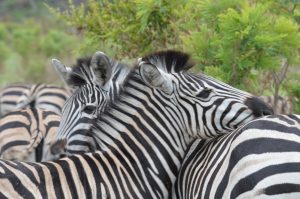
And he told me the story of the Pilanesberg National Park zebra that survived with a broken leg.
Animals in national parks are observed and counted, guides and volunteers follow their lives and share the information with the public. And so, when the poor zebra broke its leg, social media was awash with advice: “Euthanize it!” “Why let the animal suffer?” – and so on.
The guides refused to do so, and the zebra survived! It is still alive today. Hearing this story was a chance for me to reflect on my own will to survive. Would I survive? Do I fight for myself? Do I voice what I want?
Do I defend my own interests? Or do I simply wait for someone to notice, understand and help me out?
I learned another fact about the wild. Before, I used to think zebras were simply cute stripped horses, but here in South Africa I’ve discovered they were strong, independent animals. Zebras fight. Zebras do not yield. According to Gabrielė Štaraitė, author of the book Apie Afrikos žmones ir žvėris (On the People and Animals of Africa)[2], when colonisers first arrived to this continent, they wanted to use zebras as working horses. A horse is a horse, they reasoned, the only difference being that African horses are striped.
So why not use them?
And then? They failed. They failed then and would probably fail now. The animals of Africa aren’t tamed or used for work. This was news to me.
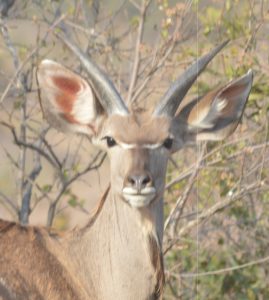
Another time, while driving with our guide, we noticed some antelopes. All of a sudden, they turned towards the bushes and froze. There was tension in the air that made hair on your neck stand up. “Look,” the guide said. “Must be a leopard coming from that direction.” Bet the antelopes did not run and had even moved closer to danger.
“What are they doing? How strange!” I said to the guide. “If I were an antelope with such quick runner’s legs, I’d be long gone.”
“Antelopes aren’t like that,” he explained. “Why run and waste energy if you don’t know where the leopard is? First you need to see it, predict where the attack will come from, and only then choose the direction for flight. It is important to let the predator see you noticed it – it loses the element of surprise and can no longer catch you unawares.”
Shouldn’t we all do the same? Not run at the first sign of trouble, but try to understand what the problem is? What the best solution is? Fight or flee? And if you flee, where to? Retreat can be a good strategy, as long as you know what you’re aiming for.
I spent a long time reflecting on what I learned in Africa. I thought about zebras, antelopes, predators. I had believed animals only attack when they’re hungry: not true. As the guides explained, if a lion gets a chance to maul you, it will. If it can take over your territory, it will. In a pride of lions, the strongest is the first one to feed, and it does not share, but eats until it drops down on its back.
In the natural world, it is the strong that survive. Does this mean nature is cruel? No. Nature is neutral. What’s important is what you are like. You are either able to survive, or not. You are either strong or not. There are no other options.

I live in the Republic of South Africa, which has been ranked 7th out of 193 United Nations member states in organised crime by the Global Initiative Against Transnational Organised Crime[3]. Living here, I realised I’ve stopped valuing all we have in Europe: security, democracy, various rights. All of that seemed normal, taken for granted.
Not so in South Africa. “Will anyone help me if I get attacked on the street?” I once asked a police officer. “No,” he responded. “You are responsible for your own safety. Mind where you are going, what you are doing. Be alert, but don’t show you’re scared.” Criminals (just like predators) can smell fear and always go for the weakest.
At first I was very frightened. I still am, but my fear is different. Knowing that safety is up to me, I feel more responsible, more focused, vigilant
I’m not sure how or when I got used to thinking that someone else will take care of me, that someone else is responsible for my safety, health and even motivation. It is easy to live like that, so easy in fact, that I forgot it didn’t always used to be this way, and in many places still isn’t. And might not be for a very long time.
The possibility to live in different surroundings was a wake-up call for me. It’s embarrassing to think how much time and energy I used to spend on empty ruminations, worries, negative thoughts. I remember how I used to run from anything that seemed difficult or inconvenient.
The lesson about strength and responsibility that I’ve learned in Africa brought to mind the legendary phrase form Mario Puzzo’s Godfather: you have to make a move from strength, not from weakness. I can now say I truly understand the meaning of these words.
Now, every time I need to make a decision, I ask myself: am I doing this from strength, or simply running? If I realise I’m looking to escape, I stop. Just like the antelopes.
Have I truly learned this lesson? Will I stop running and be strong and responsible forever? I doubt it. It’s likely I will soon return to my old habits: I will fear, complain, give in to sadness.
But I bought myself a shawl decorated with zebras – as a reminder of how much strength I have in me.
[1] https://doerlife.com/an-anthropologist-explains-the-first-sign-of-civilization/
[2] https://www.knygos.lt/lt/knygos/apie-afrikos-zmones-ir-zveris/
[3] https://www.iol.co.za/the-star/news/sa-the-7th-most-dangerous-country-in-the-world-bff32c38-b46b-412b-8fb1-2d3bf54e450d